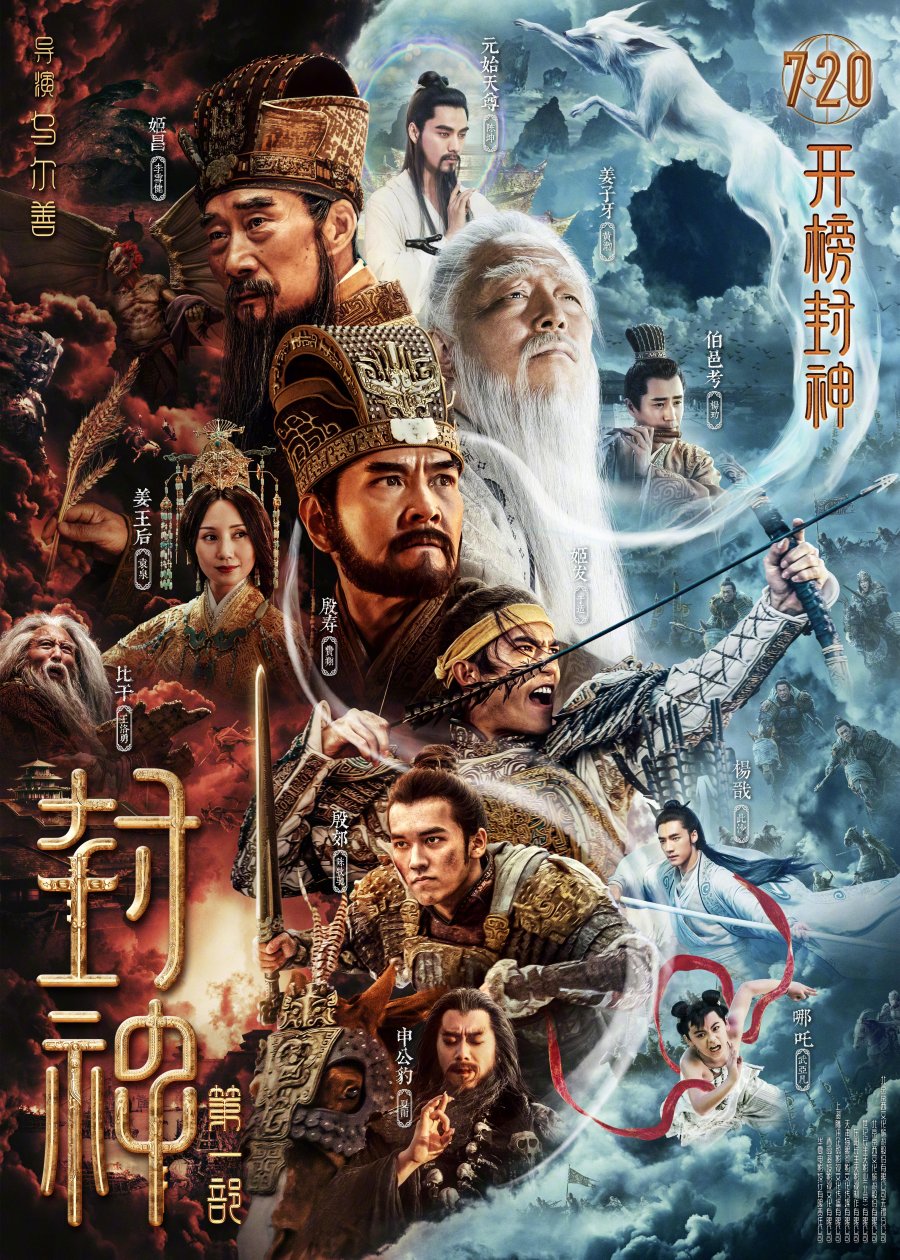
In 2018, a project helmed by director Wuershan began production: a trilogy of blockbusters budgeted at over 1.3 billion yuan ($180 million), based on a classic of Chinese literature – Investiture of the Gods – so ambitious it was immediately announced as “China’s Lord of the Rings”. And then, nothing. For years, news was scarce. After a short teaser released in 2019, the project went completely radio silent. Rumours started appearing on Chinese forums and websites in Spring 2023: The first part of the Fengshen trilogy is finally ready and coming to Chinese theatres… this July! A massive marketing machine was set in motion, and suddenly, the mythological blockbuster took hold of the local box office, grossing 2.2 billion yuan, making it the 5th biggest film of 2023 in China.
Three thousand years ago, the Shang dynasty experiences great turmoil as the ambitious prince Yin Shou sets a plan in motion to seize control of the throne and become the king of all realms. His actions are so shockingly immoral that the gods themselves decide to intervene, sending the wise Jiang Ziya and his helpers Nezha and Yang Jian to sort things out. The young Ji Fa, who is best friends with the new king’s son and a former prisoner turned royal guard, is cast in the midst of this imperial and divine struggle. Will the Shang dynasty survive?
Investiture of the Gods is such a central part of Chinese culture that most audience members in China are extremely familiar with all the characters that inhabit this world. The previous big-screen adaptation of the novel was none other than the incredibly fantastical League of Gods (2016), a CGI-laden action blockbuster that sought to push the boundaries of what was visually possible in Chinese cinema, but which largely failed as a piece of mythological storytelling.
The importance of the Investiture novel cannot be overstated, as it tells the story of the transition from the Shang dynasty to the Zhou dynasty, from barbarism and immorality to order and righteousness. The downward journey of Nezha and Jiang Ziya from Kunlun (the gods’ realm) to Earth is often interpreted as a movement from felicity to decadence and suffering, a necessary step in the quest to restore harmony between the heavens and mankind. In a nutshell: the story of the birth of Chinese civilization.
Creation of the Gods is almost the total opposite of League of Gods: while the 2016 movie was a non-stop CGI action extravaganza, Wuershan’s film chooses to focus on its characters and mythological worldbuilding. The movie does open on an impressive battle in the snow, starting with an expansive siege, and ending with an intimate skirmish on an isolated mountain side. It’s a propulsive, exciting prologue that introduces a good chunk of the characters and establishes the aesthetic approach of the film – that is, a drama-driven spectacle where the stakes hinge on matters of loyalty, family, honour, and morality.

For the rest of its runtime, save for one scene set in Kunlun and the final act, Wuershan mostly stands his ground, favouring court intrigue, luxurious sets, and character development to action spectacle or CGI madness. Meaty characters have always been a staple of the director’s works, even if none of his films since 2010’s The Butcher, the Chef, and the Swordsman have attained the same levels of idiosyncratic writing, and he manages to make the main protagonists of the Fengshen saga reasonably relatable, especially adopted Shang warrior Ji Fa (destined to accomplish big things), his friend the morally tortured prince Yin Jiao, and the evil new king himself Yin Shou.
The aforementioned Kunlun scene might be the weakest of the film, relying too much on questionable CGI and immaterial sets (pulling it dangerously close to the myriad of direct-to-streaming fantasy films Mainland China produces every year), but thankfully, the film moves away from it quickly and never looks back. Even the supernatural creatures that take part in the final chase/battle appear more grounded and tangible. The superpowered Nezha/Yang Jian duo, who segue in and out of the story, showcase impressive abilities but never feel out of place.
Many of the recent fantasy action films that have come out of China have espoused a more overtly supernatural approach, giving centre stage to all sorts of creatures and monsters, and sometimes embracing a near total immateriality in the way their bodies are incarnated on screen, for instance in League of Gods or L.O.R.D: Legend of Ravaging Dynasties. Even the ones directed by extremely talented filmmakers, like Jade Dynasty (Ching Siu-tung) and the Detective Dee trilogy (Tsui Hark) can at times reach points that bring them dangerously close to breaking suspension of disbelief. With trends showing a declined level of interest from the audience for these kinds of films, and with the ever-growing success of war films (The Battle at Lake Changjin, Wolf Warrior II, Operation Red Sea, The Eight Hundred), one could have wondered if the time for a Fengshen adaptation had passed.

But it seems Wuershan’s bet paid off. The film’s success might in part be attributed to his decision to reclaim the fantasy epic through a more grounded style. Gods and monsters still inhabit our world, but they are not the main focus of the film: this is a story of men, whose fate in the face of history is sealed through their actions and their morals, regardless of their powers. The narrative structure and its flow never come close to the perfection that was Peter Jackson’s Fellowship of the Ring, but holding any film to that standard (even Jackson’s other works) seems unfair, and perhaps it is better to understand the comparison made by the producers as a simple point of reference for international audiences: Creation of the Gods is an ambitious fantasy saga led by multiple protagonists that aims to tell a primordial story.
Most importantly, it marks a departure in the genre as it finally prioritises mythological worldbuilding and character interactions over flashy superpowered battles. The actors all do a satisfying job, but the vast majority of faces will be unknown to western audiences. Singer Fei Xiang, who had a supporting role in Painted Skin: The Resurrection (2012) from the same director, becomes the centre of attention here as the main antagonist, decadent and scheming king Yin Shou. His presence overshadows most of his co-stars, although the younger Luke Chen Muchi, who plays his son, holds his ground well enough. It is perhaps actress Narana Erdyneyeva, of Russian-Mongolian descent, who gives the most compelling performance as Su Daji, the demon-possessed mistress of the king – the genre’s equivalent to the role of femme fatale – and one of the main narrative drives of the story.
Those who expect an action extravaganza will not get what they are looking for here, at least not in this chapter. The sequels, for now scheduled to be released in 2024 and 2025 (all were shot back-to-back), will no doubt up the ante in terms of pure spectacle as they will focus on the Shang’s attack on the predynastic Zhou, and then on the Zhou’s retaliation. But for all its little flaws – a distracting Kunlun scene, a somewhat generic score that lacks strong themes, a tendency to condense major events in short temporal spans – Creation of the Gods: Kingdom of Storms emerges as a compelling take on the foundational myth of Chinese civilization, and a refreshing revamp of the country’s mythological epic formula. If Wuershan stays the course and sticks the landing, Investiture of the Gods might very well get the adaptation it deserves.
Creation of the Gods: Kingdom of Storms opens in select US theatres on September 22nd, 2023. Thanks to Sarah Clinton from Well Go USA for making this review possible.
Creation of the Gods: Kingdom of Storms – No European release date yet
Directed by Wuershan
With Fei Xiang, Luke Chen Muchi, Narana Erdyneyeva


 Film Exposure
1 commentaire »