English
FF 2023 – 100 Yards: Formalist Perfection in Service of a new Martial Arts Masterpiece
Rarely have modern martial arts films showcased such an exceptional level of formal control.
 Film Exposure
Site consacré au cinéma proposant des articles de fond et documentés.
Rarely have modern martial arts films showcased such an exceptional level of formal control.
 Director Xu Haofeng has been making the most idiosyncratic martial arts films in the world for a good few years now – from his dry comedic twist on the genre with The Sword Identity, to The Final Master, a sardonically realistic take that turned martial arts into a political and strategic tool. After his 2017 film The Hidden Sword got shelved by the Chinese censors (they won’t say why), Xu Haofeng is finally back (in partnership with new filmmaker Xu Junfeng) with 100 Yards, easily one of the best and most fascinating action films to have come out in recent years.
In 1920 Tianjin, a martial arts master who is about to die must choose a successor for his school: his son, or his best student. To select his heir, they must fight, and the student wins. But it is only the beginning of a complex game of egos and twisty manoeuvres between the two men, who will have to duel again and again through varying circumstances to prove to the world who really deserves to take the master’s place…
You want to know which action film delivers the most elegant camerawork of the year? Look no further. In 100 Yards, the cameras are panning, moving, following the scenes’ action with fluidity. During the fights, the emphasis is always on clarity and precision. There are very few inserts, no slo-mo, no overlapping editing for spectacle, but lasting medium shots that encompass the fighters’ whole bodies, presenting yet again a “naturalistic” vision of martial arts in a way that feels almost didactic which, coupled with the tools of the medium (especially the sound effects – oh my God, the sound effects – with every punch, kick, block, parry, every movement through the air like hearing honey melt in your ears), delivers maximum impact and viewing pleasure.
The choreography, of course, is of the highest order, alternating between hand-to-hand combat and various weapons (short sabres, swords, triangles, spears, long sticks). Verisimilitude and immersion are the core factors here, and if there is one thing it can teach us, it’s that martials arts don’t need to be stylistically magnified to be impressive and awe-inspiring. Director Xu Haofeng and co-martial arts director Duncan Leung (classmate of Bruce Lee and disciple of master Yip Man) deliver their own exciting take on the forms and styles, always retaining the feeling of traditional martial arts films.
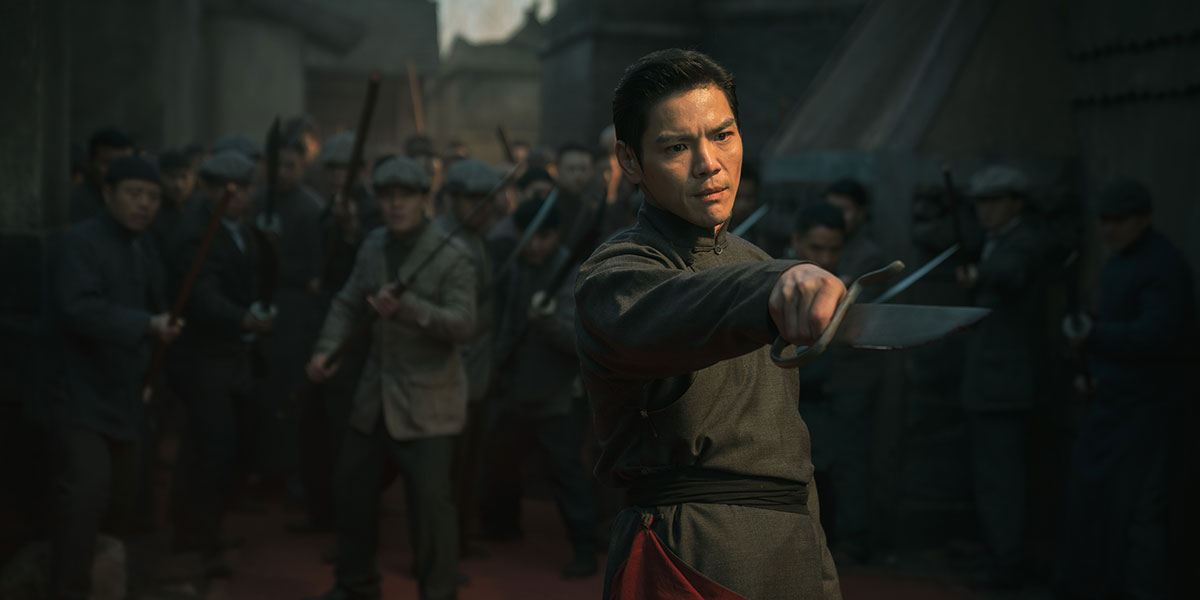
The moving camera is used to enhance viewer’s involvement by operating changes in points of view, switching from a third-person omniscient POV to that of an observing character, then back to a neutral perspective. A duel’s rules are broken because of the fighters’ egos, leading to an unnecessary casualty, and the fighters to be detained, only for the camera to end the scene on a pan to the giant wall murals of the old masters, silently looking down upon them.
What sets 100 Yards apart from most of the modern action films is that this is not a movie about violence. It never revels in the consequence of the fights (deaths or injuries, although they do happen), but is solely interested in their form. Deadly final strikes always stop short of hitting their target – violence is never the point, for we know who the victor is. The film contains a whole sequence where one of the protagonists traps his opponent in a street fight, surrounded by dozens of hoodlums, the sole purpose of the scene being to teach the character the Short Saber Form, or rather, teach him why this form led to his opponent losing their previous duel (which occurred just minutes before).

The Xus mise-en-scène is very playful, consisting mostly of long takes that make optimal use of space and furniture, introducing new characters through camera movements, with characters introducing new objects nearly supernaturally, creating a flow that is almost hypnotic. He eschews close-ups in favour of dolly-ins, cuts in favour of whip pans. Sometimes, the camera will call attention to itself by highlighting a detail no other director would ever highlight. The opening shot of the film starts out from behind a wall, looking (through a large hole) at the master’s student arriving at the school. The camera pivots to the left, following the character’s movement, and lets him leave the frame from the left. Anyone else would have cut right there and then, but the Xu duo adjusts the camera level down to show a better picture of the student corp… for one second. Why? This happens throughout the film, the camera guiding our eye to seemingly innocuous details again and again, as if to say that no detail is too small to be important. Everything is part of a context, every object the result of a story, every fight the vector for history, both personal and cultural.
Rarely have modern martial arts films showcased such a level of formal control. Each shot is precisely calculated to pair with a certain kind of action, and the action design itself progressively expands to include more variety, turning the film yet again (as Xu did in the climax of The Final Master) into a sort of cinematic treaty on the martial arts genre, studying, observing, examining every possible use and outcome of certain styles and weapons.
Amidst the martial ballet, both main actors – Jacky Heung and Andy On – seize complete control of the screen with their charm and charisma. Heung’s arc as a beaten but determined man quickly proves emphatic, even if he is not above manipulating situational parameters to attain his goals. On, at first cocky and condescending, commands admiration but also a certain amount of fear. Both are incredibly convincing, both as actors and martial performers.

100 Yards is a film about the rules, how to navigate them, bend them, circumvent them sometimes. How even the masters must abide by them. It’s about the dissolution of society because of modernity (banks, factories, chambers of commerce, colonial influence), about the ability of martial arts to solve any and all disputes, about martial artists’ struggle to be seen as anything but bodies of spectacle. In 100 Yards, no one fights because they’re good or evil, no one fights because they want to inflict pain upon another person. In 100 Yards, people fight because they are part of a system: the hoodlums at the market, the martial arts disciples, and of course, the heirs to the master’s chair, for whom each strike might very well determine their future.
The action genre has rarely been so alive, so dynamic on a global scale, but it is struggling with a handful of tropes that constantly threaten to turn well-intentioned films into showreels, to reduce the combined work of dedicated craftspeople into a collection of poser shots and oners. Xu Haofeng seems immune to all of that. His films are never about doing more (more blood, more speed, more stunts, more violence), but they’re always doing something different, all the while delivering some of the most graciously beautiful fights you have ever laid your eyes on.
100 Yards – No European release date yet
Directed by Xu Haofeng and Xu Junfeng
With Jacky Heung, Andy On, Bea Hayden Kuo

 Film Exposure