English
FF 2024 – ESCAPE FROM THE 21st CENTURY: Time Travel, Street Fighter II, and The End of Adolescence
Action sci-fi coming-of-age pop culture remix. Too much?
 Film Exposure
Site consacré au cinéma proposant des articles de fond et documentés.
Action sci-fi coming-of-age pop culture remix. Too much?

Cinema can be a force to be reckoned with – a tool to articulate the feelings associated with certain parts of life, but also a tool that must be used with clarity of purpose. Just imagine: Following a chemical accident, three 18-year-old boys in the summer of 1999 discover they can take control of their 38-year-old bodies in the future by sneezing. Sneezing in the future brings them back into the past. Soon, they must contend with corrupt journalists, deadly organ traffickers, brotherly rivalries, and the desire to never grow up… among other things. Escape From the 21st Century is many, many things: an attempt at a soft sci-fi blockbuster, an exploration of teenage angst, a multireferential pop culture remix, a claustrophobic dystopia, a coming-of-age animation-enhanced actioner, and a silly comedy. Too much? Or possibly too little?
The intriguing set-up has a lot of heavy lifting to do, introducing three main characters (Chengyong, Wang Zha, and Pao Pao) and their motivations, its supernatural concept, and two strikingly different time periods. As much as the dynamic direction and fluid editing help streamline the exposition, it still feels like there is something off about the first act: each time one of the main characters sneezes into the future, it feels like things are going too fast. Other characters give them information without finding them weird enough, or the heightened action kinetics do not seem to surprise the protagonists the way they should.
Sometimes, directing choices stand out as puzzling or devoid of purpose: An upside-down shot of the speeding van in the middle of a chase? An aspect ratio shift from ultra-widescreen to 4:3 (or similar) that does not translate a change of time period? (4:3 is otherwise used for the year 1999 and ultra-widescreen for the year 2019 throughout.) During one scene, we see Chengyong literally grabbing a piece of the subtitles to look at it closely. Later, the character of Liu Lianzhi complains about a “useless montage” we just saw. While these details might sometimes elicit a smile or chuckle, they mostly deepen emotional distance, weaken immersion, and give the film a self-conscious dimension that goes against the rest of the narrative.
Although it includes elements of comedy, the film is otherwise a straight coming-of-age sci-fi romp that sometimes mixes animation to the proceedings. Some will think of Scott Pilgrim vs The World from a visual standpoint, but the movie mostly comes off as a logical continuation of director’s Li Yang career. His sole other feature length film is Lee’s Adventure (2011), co-directed with Frant Gwo (of Wandering Earth fame), a movie that was already visually quite unique, mixing live-action and animation, and also heavily influenced by video game aesthetics. In that film, the protagonist discovered he could randomly travel through time by entering some kind of trance through playing video games at an extreme level. It was one of the most notable modern forays of Mainland China into cinematic science-fiction, and a clear signal the industry was adopting and adapting elements of foreign blockbusters for its local market. With only a couple of short films made in-between, Escape From the 21st Century is Li Yang’s striking return to entertainment filmmaking – he’s directing solo this time – and the overarching importance of video games once again plays a key role in the narrative.
However, as was the case with Lee’s Adventure, it would be a mistake to see this new film as hard sci-fi despite the illusion of logical reasoning it seems to offer at times. Consider the following: The opening narration tells us the story takes place on another planet, Planet K. The year is supposedly 1999, but we’re only a few seconds in and already have too many burning questions: 1999 from what point of reference? 1999 A.D. like on Earth, or 1999 since the settlement on Planet K? Was it even a colony, or is it about another species that evolved in parallel to Earth humans? For a while, the film leaves us hanging… In the second act, there is a joke about swiping a smartphone screen: since the character comes from 1999, he has no idea what that means and takes a paint brush to swipe his screen with paint. On top of being an unfunny joke, the technological shift depicted implies that Planet K is on the same technological timeline as Earth, but this seems implausible in both theories (colony or not). In the third act, there is a short flashback to the year 945 about a certain “Country V” running out of fighter jets. The flashback is used to explain another plot point involving ravens (yes, it’s a bit all over the place), but it also firmly confirms Planet K vastly diverges technologically and historically. Depending on one’s interpretation of the film, this inconsistency may retroactively weaken many other scenes, which display a very analog technological aesthetic (old 90s style PCs, old recording tapes, and so on)…
The first taste of causality in the film is given around 30 minutes in, when the main trio tries to find their community watch lady, Ms. Busy, in the future. In spite of their best efforts, it is revealed they cannot find her because no matter what they do, it seems impossible to alter the course of history. Later, they try to win the lottery by checking winning numbers in the future, and then playing in the past. It does not yield any results because fate turns out to be the overarching principle: the numbers do not matter, only the winner does.
Other times, the causality makes no sense at all, and it even prevents the film from developing a situational idea that could have resulted in one of the coolest action set pieces in history: when two characters start fighting in a 2019 restaurant, one of them throws pepper around, which makes them sneeze. They both suddenly wake up in class in 1999 and continue the fight. There was the opportunity for a high concept set piece the likes of which we rarely see, but the film soon breaks logical continuity without any explanation.
The key to making it all make sense is to remember we are seeing all of this through the eyes of three 18-year-old boys. When they theorise the chemicals in the lake they fell in in the beginning messed with their bodies, making it possible for them to sneeze themselves across time, one of them replies: “This explanation is unscientific.” And his friend retorts, “It’s the best explanation you’ll get from a 9th grader.”
And it’s also the best explanation you’ll get from the film, because there is nothing more to explain. The stakes are somewhere else, and Li Yang does a pretty good job at showing it visually. For instance, in the first act, when Chengyong and his girlfriend Yang Yi are sharing the same bottle of water, Pao Pao stands in the background in-between them, looking sad, his tissue falling on the ground. In the same scene, a wide shot of the public park shows a big, old-looking frog statue in the foreground (the Planet K chemicals come from a local frog species), with a space shuttle in the background, sandwiching the teenage characters between the past (destined to be abandoned) and the future (taking off to unknown horizons).
Director Li Yang is a deft crafter of images, delivering at least a handful of visually remarkable scenes. At the half hour mark, the character of Wang Zha starts taking narrative lead, pushing journalist Liu Lianzhi to rebel against a corrupt, selfish system. Just before Wang sets things in motion, Liu is sitting in a meeting room, taking a scolding from her boss, when Li Yang suddenly switches to a falling downward shot from the outside of the building (with Vivaldi’s Summer on the soundtrack), foreshadowing the actual climatic jump that takes place a couple of minutes later, this time accompanied by the well-known freedom anthem “Here’s to You” from Morricone and Baez. During the jump, the downward shot recurs but reversed 180°, and the dozens of multicoloured cables Wang Zha tore off in the office building start flowing down the broken window. The symbolically potent shot is live-action but looks close to animation and is followed by another one – that of the two characters running in a hail of old computers falling from the sky, the crimson background burning behind them.
Some will think it does too much in its childish faith for striking images, others will think it does too little to go beyond the literal sense of said images. Neither would be wrong, but the sheer energy deployed by the film makes it easy to be swept up in its joyful tide. In many instances, the film uses poetic licence to break continuity of logic in transitional scenes, like when the boys bring Liu Lianzhi to the hospital and snow comes in through the door with them; there was no snow before, and there isn’t any after this scene either.
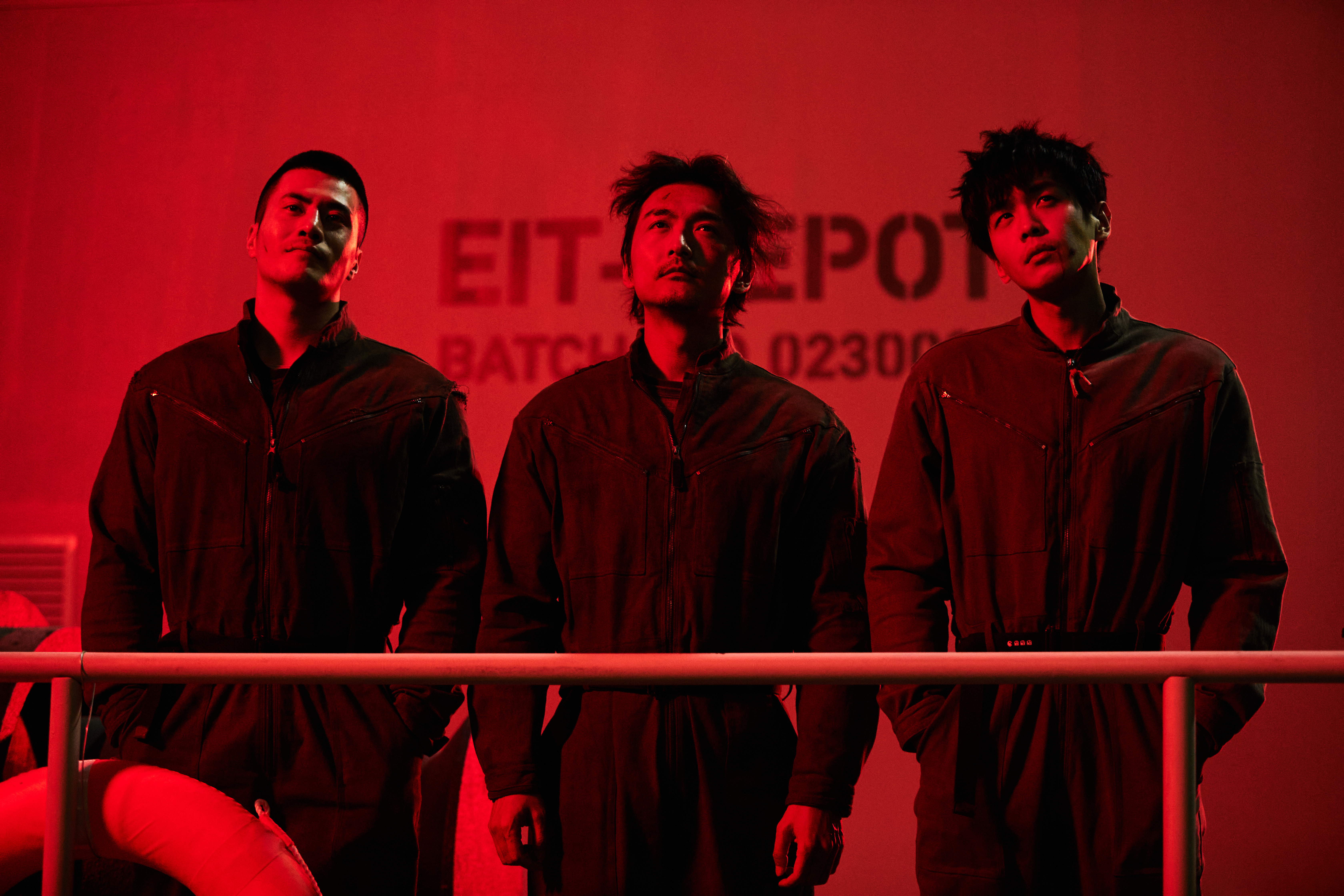
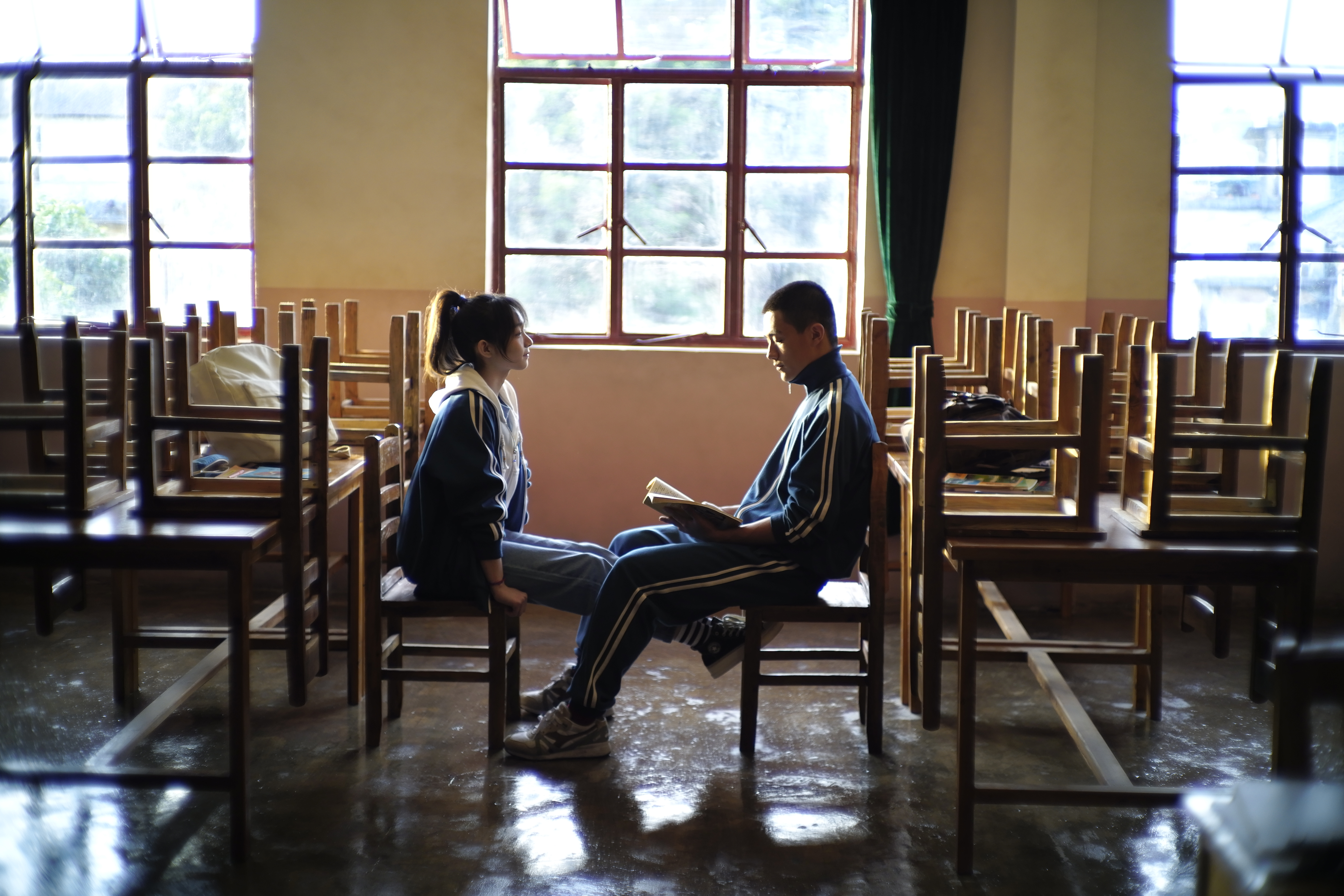
In Escape From the 21st Century, the future is shown in anxiety-inducing, claustrophobic ultra-widescreen. It is a mostly dark, drab, colourless place because it is the visual representation of how our protagonists feel about the future. In a 1999 scene, the pupils are listening to someone talking on the school speaker system: “Students. You are a new generation of great hope. Your future will be brighter than ever”, says the voice as Chengyong sits motionless at his school desk, eyes blank, and as a massive banner comes down outside the building, darkening the otherwise empty classroom. Chengyong is in the future, and he works for an illegal organ trafficking organisation. “The greatest lie we tell ourselves is that things will get better when we grow up” concludes the voice over narration.
Deep fear and resentment of the future seep through the film’s every pore. Characters lose everything their younger selves held dear and hang on to things that destroy them: “I thought I could make the summer of 1999 last forever”. Therein lie the stakes for three teenagers living through an age when everything sucks or feels designed to slow us down. How can one try to hang on to these last moments of teenage innocence? To say the approach is surprising would be an understatement, as recent Chinese blockbusters have often shied away from depicting overly dystopic visions of the country. Perhaps the teenage point of view made it possible for Li Yang to get approval from the China Film Administration.
It certainly allows him to push back against the dystopic visions with the rejuvenating forces of youth, love, and hope. “For better, not worse!” shouts 18-year-old schoolgirl Yang Yi out the window, trying to will a better future into existence. A cry for help, a cry for hope which emotional power is perhaps only equalled in the film by Liu Lianzhi’s plea to Wang Zha to find her in 1999 by listing all the things she loved as a child. A beautiful, romantic idea few films would dare to own so earnestly.
Two thirds of the way in, the story of the three boys seems to come to an end on a series of strikingly dark notes. The summer of 1999 ended, and nothing better happened to them. It is, of course, the emotional down before the upcoming conclusion, a whirlwind of jokes, scenographic ideas, and disaster/action film tropes culminating in a sequence where Ravel’s Bolero is playing while a gigantic flock of ravens unleashes a terrible substance on the population, before switching to a cover of “Holding Out For a Hero” from Bonnie Tyler while Wang Zha races through a crumbling, apocalyptic 1999 and his friends are engaged in a fight to the death with their mortal enemy 20 years later. The exhilarating final fight borrows from video games, cinema, and animation alike to deliver one of the most unique action scenes of the year, only to reach a conclusion that seems to harken back directly to the director’s previous film: “Gaming improves the mind. Addiction destroys the body”, says one of the characters triumphantly.
So, does the film do too much? It certainly feels that way at times, with a narrative that goes at breakneck pace and absolutely never slows down, jumping from one plot development to the next restlessly without giving any of them enough time to become fully formed. A possibly damning weakness for the plot-focused audience members, which the film turns into a remarkable strength for anyone ready to accept that poetic licence takes precedence over time travel logical fallacies. The glee with which the filmmaker uses conventional cultural codes (of global reach) can understandably come off as too easy or obvious, but it also translates a desire to cast as wide a net as possible in a more or less universal language.
Escape From the 21st Century is many, many things, but beyond the hit-and-miss comedy, the unsubtle but potent needle drops, the cool shots, the logical frustrations, and the Shoryukens, it is first and foremost a poetic, pulpy exploration of what it feels like to realise our childhood is about to end. A fleeting sensation one can have trouble describing or remembering, and yet Li Yang asks us to try: try and remember the light of your adolescence, what it meant for you then and what it means for you now, whether it was your high school sweetheart or Street Fight II.
Escape From the 21st Century is part of the Fantastic Fest 2024 program. Thanks to Fortissimo Films for making this review possible.
Escape From the 21st Century – No European release date yet
Directed by Li Yang
With Song Yang, Zhang Ruoyun, Leon Lee, Zhong Chuxi

 Film Exposure