English
Staging absence: HAMNET and the poetics of grief
Zhao’s latest project therefore becomes a sonnet, not because it gestures toward abstract symbolism, but because it asserts itself as a work capable of recreating space.
 Film Exposure
Site consacré au cinéma proposant des articles de fond et documentés.
Zhao’s latest project therefore becomes a sonnet, not because it gestures toward abstract symbolism, but because it asserts itself as a work capable of recreating space.
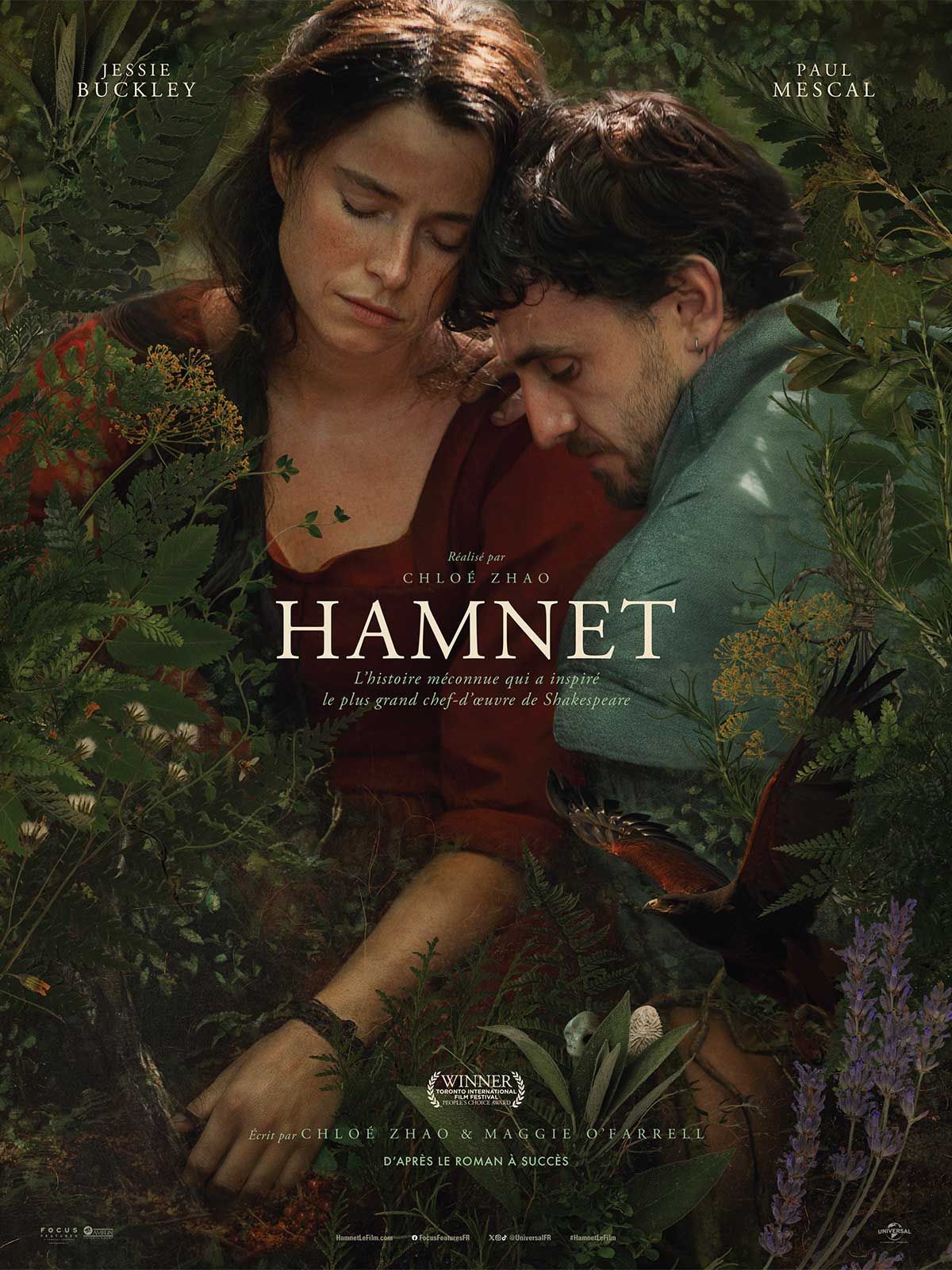 Powerful, raw, devastating and yet magnificent, Chloé Zhao’s new film continues to generate discussion, and rightly so. This adaptation of Maggie O’Farrell’s novel Hamnet immerses us in a profoundly moving experience of grief, exploring spaces laden with meaning while establishing a dialogue, both discreet and unexpected, with the literary figure at the heart of its narrative.
Whether through stage plays, films, or books, it seems impossible to pass through a single year without encountering Shakespeare’s name on a poster, catching the eye on a street corner. This comes as no surprise, of course, for one of the most celebrated authors in history, yet such omnipresence nevertheless invites a persistent question: what is it that makes Shakespeare’s works so enduringly powerful that we continue, even today, to retell and interrogate them?
At first glance, Chloé Zhao’s new film, Hamnet, does not appear to be the work best suited to answering this question. The narrative deliberately keeps the famous playwright at a distance, choosing instead to focus on the story of his wife, Agnes, and on the grief that follows the loss of their only son, the young Hamnet. As a fictional imagining of the genesis of the renowned tragedy Hamlet, the project might have risked lacking subtlety or depth, an all-too-common pitfall of works with biographical or explanatory ambitions. Yet, much to our relief, the film manages to assert its own voice by constructing a story centred on relationships and grief. And by shifting its gaze toward peripheral figures, it allows the viewer to fully immerse themselves in the narrative without any prerequisite knowledge. The Shakespearean context thus appears less as an end in itself than as a pretext, one that enables the film to explore what it truly seeks to grasp: a raw human experience, and the spaces in which it unfolds in its full intensity.
However, by developing a story exploring those themes, Chloé Zhao’s new drama proves paradoxically more Shakespearean than many contemporary adaptations that draw directly from the poet’s work. From this perspective emerges an intuition: Hamnet is not merely a film, it is also a sonnet. Not a sonnet bound by rigid rhythmic structures, excessively lyrical symbolic language, or the expression of an idealized and unattainable love, but rather a sonnet that pushes against the limits of its own conventions. A space of introspection, that confronts a complex conditional love and questions its own status as a work tested by time… in short, a Shakespearean sonnet.
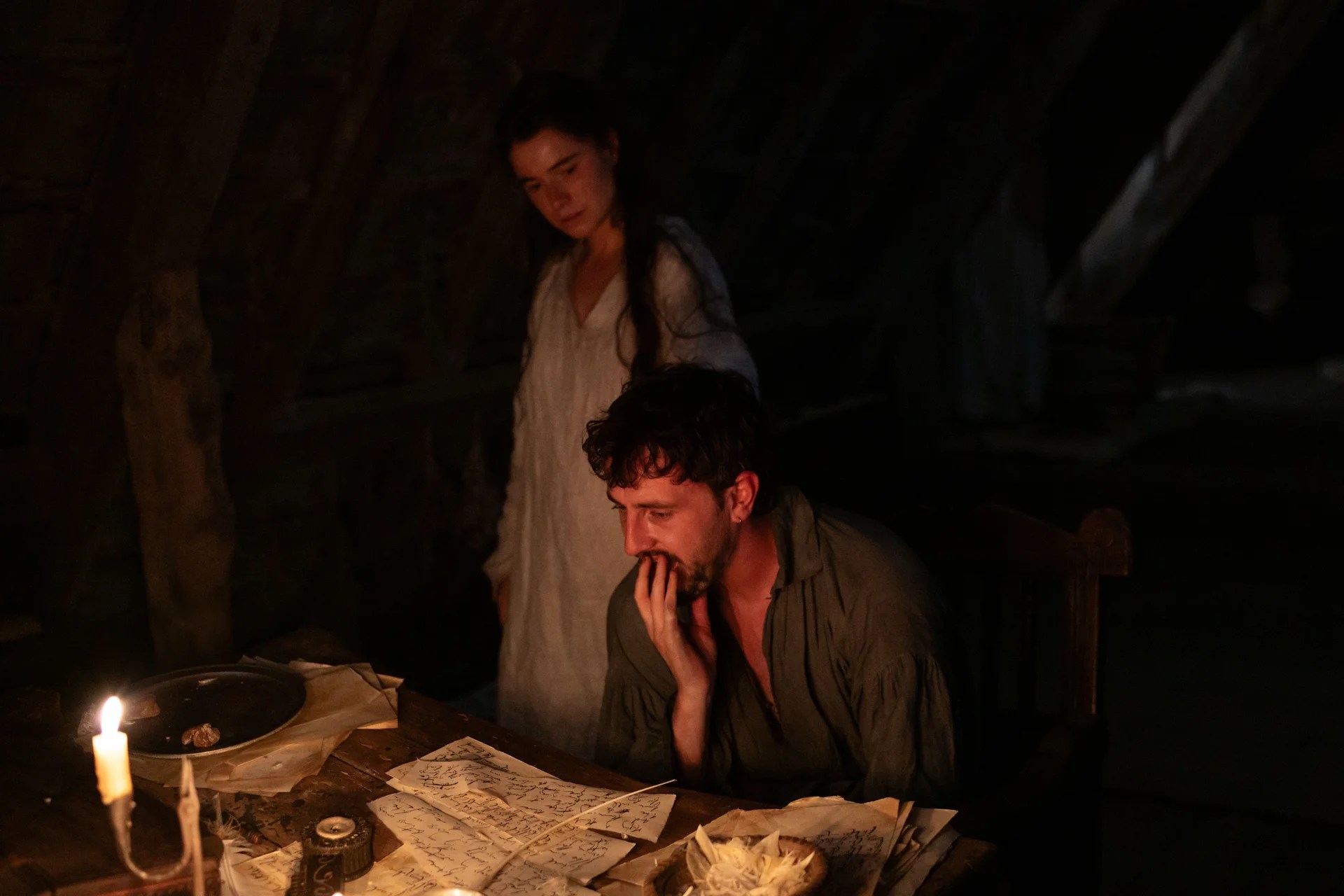 Like these specific poems, often regarded as one of the rare gateways into their author’s inner life, the film plays with the boundary between personal reflection and universal experience. Without denying the influence of the former, it ultimately chooses to place its focus on the latter. This approach gives the film remarkable dramatic and emotional depth, making this family life, and the loss that tears it apart, intensely gripping. Zhao’s camera is equally adept at intruding into the intimacy of her characters, capturing their pain through long close-ups, as it is at detaching itself from them by adopting an elevated viewpoint that gives certain moments a fateful significance. Shakespearean sonnets also maintain an ambiguous relationship to the Other: the subject of the writing may be an intimate love just as much as an excuse for the author to unfold an existential meditation. An ambiguity that finds its cinematic translation in Hamnet through the gradual distancing of the emotional bond between its two protagonists. A distance that emerges not as a true separation, but as an opportunity for the film to establish a new form of reflection and dialogue.
A dialogue between forms, certainly, but above all a dialogue between characters who do not share the same language. Agnes’s mode of expression grants the film an additional degree of complexity: through her, a metaphysical dimension unfolds, one that could be described as animist. Her relationship to the world is structured around a singular space, the forest, which becomes a privileged site of communication and transmission. The film fully embraces this perception, integrating plants and animals not as mere elements of setting, but as essential components of both the narrative and the construction of the character. Agnes thus surrenders herself entirely to this natural world, which grounds her intuitive relationship to reality. However, the loss she suffers brings about a rupture in this immediate connection to the living, akin to a faltering faith in the vital force that had previously animated the character. What remains is a void, an absence that fills the rooms of an overly large house, cutting her off from the energy that once connected her to the world around her. This void is also felt by William, who, conversely, seeks refuge in the crowded streets of London, desperately attempting to give form to this absence, to recover a space, endlessly asking himself “where” his son could possibly have gone.
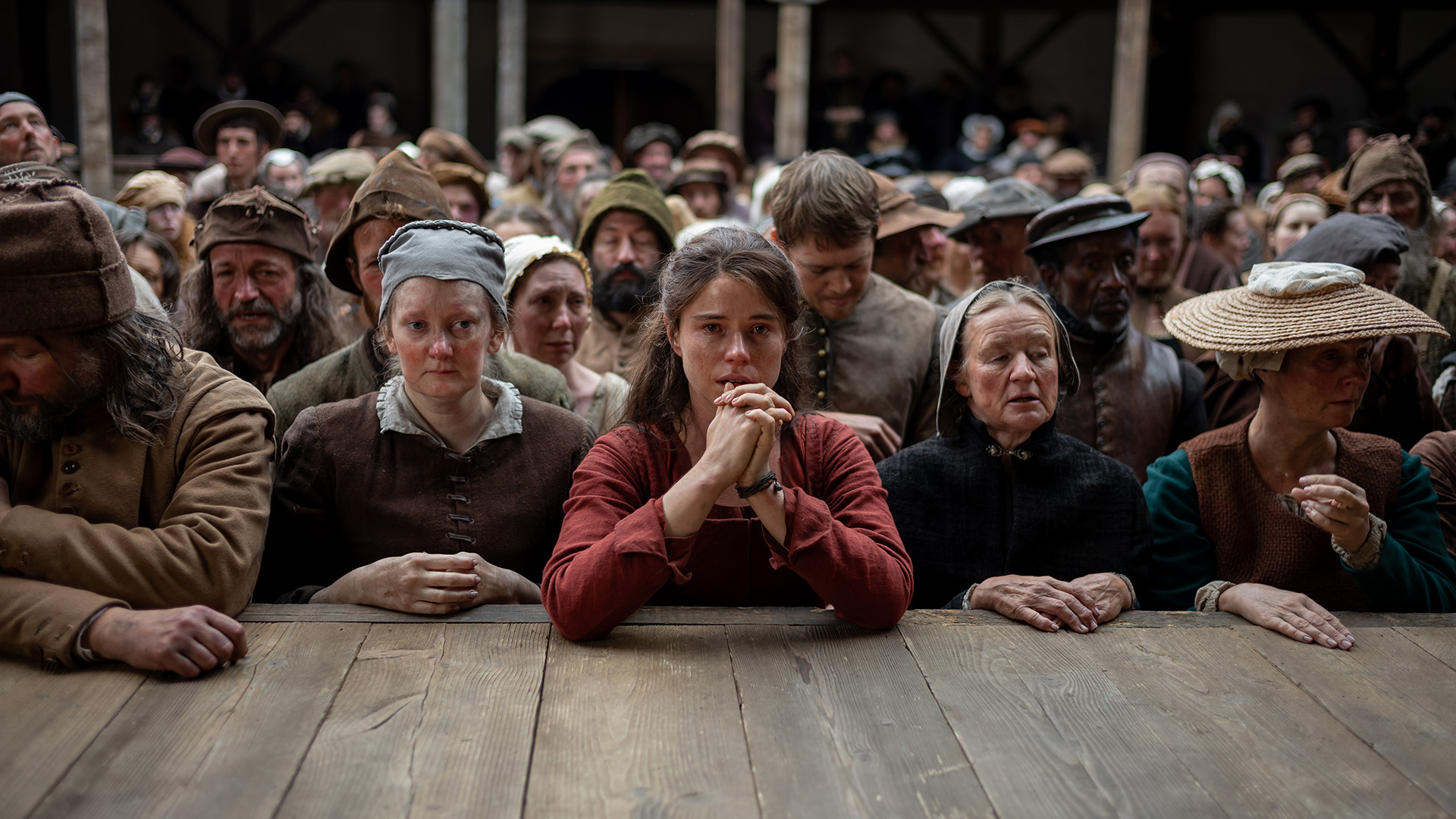
The film elevates these absences, rendering loss and emptiness visible by isolating its characters from the spaces they ought to inhabit. Its true tour de force, however, lies in its conclusion, where it reveals the artwork’s power to both immortalize and reunite. Fiction not only allows grief to be expressed and transformed but also creates an essential and indissociable bond between creator and spectator, a bond without which no work of art can truly exist. In Hamnet, the theatre thus becomes this ultimate site: a space that takes physical form to gather and envelop the protagonists, who find one another again through the play unfolding before them. Through Agnes’s recognition of this force, and of this possibility of reclaiming a vital space, the film positions itself as the continuation of this very message, becoming in turn an object that is both embodied and transcendent.
Zhao’s latest project therefore becomes a sonnet, not because it gestures toward abstract symbolism, but because it asserts itself as a work capable of recreating space. A space where souls can express themselves, encounter one another, and endure. It reflects the aching realization that if the artist and their subject are not meant to survive, the work itself possesses the power to persist “so long as men can breathe or eyes can see.” The culmination of a desperate search for a place that has ceased to exist, yet is granted the chance to reemerge in another form, whether theatrical, literary, or cinematic.
“So long lives this, and this gives life to thee.”
Of striking beauty and breathtaking force, Hamnet establishes itself with quiet confidence within an already abundant field of works seeking, directly or indirectly, to engage in dialogue with the oeuvre of the famed poet. It manages to distil its essential qualities, being human, vulnerable, and universal, while reminding us that the playwright’s work was never intended solely for scholars, but has always spoken to the widest possible audience. But beyond all the subtleties the film manages to deploy, it will remain memorable for one essential reason: its profound acknowledgment of the power of a work of art to move us to tears, even centuries after the disappearance of its creator.
HAMNET
Directedy by Chloé Zhao
With Jessie Buckley, Paul Mescal, Emily Watson

 Film Exposure